Peak Force vs. Felt Recoil: What Our Battle Stock Testing Actually Measured
Most shooters talk about recoil by feel.
They say a rifle feels sharp, soft, flat, punchy, smooth, or overgassed.
That matters. Felt recoil is real. It affects confidence, control, follow-up shots, and how long a shooter can train before fatigue sets in.
But feel alone is not enough.
That is why Battle Brace tested the Battle Stock with the Recoil-IQ precision recoil measurement device. Instead of relying only on opinion, we measured the recoil event through actual force data.
What Is Felt Recoil?
Felt recoil is what the shooter experiences behind the rifle.
It includes the push into the shoulder, the sharpness of the hit, the way the sights move, how quickly the rifle settles, and how much effort it takes to stay in control.
Two rifles can fire the same caliber and still feel very different.
Why?
Because recoil is affected by more than cartridge size.
The stock matters.
The buffer system matters.
The spring matters.
The gas system matters.
The muzzle device matters.
The shooter’s position matters.
The entire weapon system changes how recoil is felt.
What Is Peak Force?
Peak force is the hardest single hit recorded during the recoil event.
In plain English, it is the sharpest impact the rifle sends into the shooter.
That is why peak force matters. A rifle with a high peak force may feel more violent, even if the total recoil event is short. A rifle with lower peak force can feel smoother and more controlled because the hardest hit is reduced.
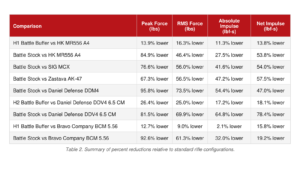
In Battle Brace testing, the Battle Stock produced major peak-force reductions across multiple platforms.
Examples from testing included:
- 95.8% lower peak force on the Daniel Defense DDM4
- 84.9% lower peak force on the HK MR556 A4
- 81.5% lower peak force on the DDV4 6.5 Creedmoor
- 76.6% lower peak force on the SIG MCX
- 67.3% lower peak force on the Zastava AK-47
That is the difference between guessing and measuring.
Why Peak Force Matters to the Shooter
Peak force is not just a lab number.
It helps explain why one rifle feels harder on the shoulder than another.
A lower peak force can help with:
- Less sharp rearward impact
- Better control during rapid fire
- Faster follow-up shots
- Better sight tracking
- Less shooter fatigue
- More confidence behind the rifle
The shooter may describe it as “softer,” “flatter,” or “less violent.”
The data describes it as lower peak force.
Different language. Same idea.
What RMS Force and Impulse Tell Us
Peak force is the hardest hit, but it is not the whole recoil story.
Battle Brace also measured RMS force, absolute impulse, and net impulse.
RMS force helps show the overall harshness of the recoil event from start to finish.
Absolute impulse shows the total recoil load delivered through the system.
Net impulse shows the remaining directional push after the recoil cycle plays out.
That matters because recoil is not just one spike. It is an entire event.
A good recoil-reduction system should not only reduce the hardest hit. It should improve the overall recoil profile.
That is what the Battle Stock testing showed.
Why the Stock Matters
Most shooters look at the front of the rifle first.
They think about muzzle brakes, compensators, suppressors, barrel length, and gas tuning.
Those parts matter.
But the rear of the rifle is where the shooter receives the recoil.
That is why the stock is so important.
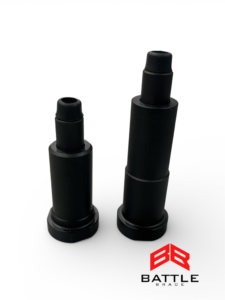
The Battle Stock for AR-15 platforms was built to change how recoil transfers into the shooter. It is not just a replacement stock. It is part of a recoil-management system.
For firearms with a rear Picatinny mounting interface, the Picatinny Battle Stock brings that recoil-control concept to a different mounting system.
Final Takeaway
Felt recoil is what the shooter notices.
Peak force is what the data measures.
Both matter.
Battle Brace testing showed that the Battle Stock can reduce the hardest part of the recoil event while also improving the overall recoil profile across tested platforms.
That is why measured recoil reduction matters.
It gives shooters, dealers, and manufacturers something better than opinion.
It gives them data.
Explore the Battle Stock for AR-15 platforms, view the Picatinny Battle Stock, or read the Battle Stock Installation Guide for setup and compatibility.
Disclaimer: Test results reflect specific tested rifle configurations, ammunition, equipment, and conditions. Results may vary by platform, setup, shooter, and configuration.