Stock vs. Brace: What Is the Difference Between a Rifle Stock and a Stabilizing Brace?
The difference between a rifle stock and a stabilizing brace is one of the most misunderstood topics in the AR-15, AR pistol, AK platform, and firearm accessory world.
To the average shooter, both parts attach to the rear of a firearm. Both can affect stability, recoil control, weapon handling, and how the firearm feels under live fire. But from a design and classification standpoint, a rifle stock and a stabilizing brace are not the same thing.
That distinction matters.
It matters for shooters trying to understand their setup. It matters for dealers explaining products correctly. It matters for manufacturers designing firearm accessories in a heavily scrutinized industry.
At Battle Brace, this is more than a terminology issue. Rear firearm accessories live in a space where function, geometry, dimensions, intended use, marketing language, and regulatory interpretation all matter. A product cannot simply look good or feel comfortable. It has to be designed with purpose.
The Basic Difference Between a Stock and a Brace
A rifle stock is traditionally designed to be placed against the shoulder.
A stabilizing brace, often called a pistol brace or arm brace, was originally designed to help stabilize a pistol-style firearm by supporting the shooter’s forearm.
That is the basic difference.
A stock is built around shoulder-fired use.
A brace is built around arm support and stabilization.
The reason this gets complicated is because firearm classification is not always based on the name printed on the product box. A part called a “brace” may still be evaluated based on its actual design, shape, dimensions, surface area, attachment method, and how it is likely to be used.
In other words, the label is not the entire analysis.
Design matters.
Function matters.
Intent matters.
Overall firearm configuration matters.
What Is a Rifle Stock?
A rifle stock is a rear firearm component designed to interface with the shooter’s shoulder.
The purpose is practical. A stock gives the shooter a rear point of contact, helps stabilize the firearm, improves control, and allows recoil to be managed through the body.
On a traditional rifle, the stock is a major part of the shooting system. It affects sight alignment, cheek weld, length of pull, recoil transfer, weapon control, and follow-up shot speed.
On AR-15 rifles and other modern sporting rifles, the stock also interacts with the rear of the firearm in a way that directly affects how the rifle feels. The rear contact point is where much of the recoil impulse becomes noticeable to the shooter.
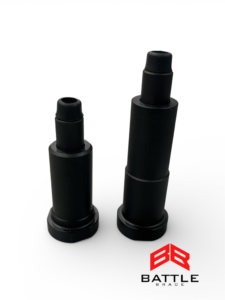
This is where products like the Battle Stock for AR-15 platforms become important. A rifle stock can do more than provide a place to shoulder the firearm. With the right design, it can become part of a broader recoil-management system.
For firearms that use a rear Picatinny mounting interface, the Picatinny Battle Stock for AK platforms brings that same recoil-control concept to AK-style platforms and other compatible weapon systems.
What Is a Stabilizing Brace?
A stabilizing brace is different from a rifle stock.
The original concept behind a stabilizing brace was to help support and stabilize a pistol-style firearm, especially when used with the shooter’s forearm. The brace was not originally designed to create a shoulder-fired rifle. It was designed to help control a large-format pistol.
That difference is the center of the stock-versus-brace discussion.
A brace may include features such as a cuff, strap, flexible rear section, or geometry intended to support the forearm. The design goal is stabilization, not traditional shoulder-fired use.
The difficulty is that braces have changed over time. Some braces are minimal. Some are adjustable. Some are rigid. Some resemble known stock designs more than others. That variety is one reason the topic became so controversial.
As pistol braces became common on AR pistols and other large-format pistols, regulators began looking more closely at whether certain brace-equipped firearms were being designed, marketed, or configured in a way that made them more like shoulder-fired rifles.
Why the Stock vs. Brace Issue Matters
The stock-versus-brace issue matters because firearm classification matters.
Under federal law, a rifle is generally defined around whether the firearm is designed, made, and intended to be fired from the shoulder. That phrase is central to the entire discussion.
If a firearm is classified as a short-barreled rifle, or SBR, it can fall under the National Firearms Act. That can bring additional registration, transfer, possession, and compliance requirements.
That is why the rear accessory on a firearm is not just a cosmetic part.
A stock, brace, buffer tube, rear adapter, or Picatinny-mounted rear accessory can influence how the firearm is understood as a complete system.
For the shooter, this can affect configuration.
For the dealer, this can affect product explanation.
For the manufacturer, this can affect design, testing, marketing, packaging, and compliance review.
The ATF Worksheet 4999 Point-System Issue
A major part of the public conversation around pistol braces came from ATF’s proposed Worksheet 4999.
Worksheet 4999 was a proposed point-style evaluation system released as part of ATF’s 2021 brace-related rulemaking. The idea was to evaluate certain features of firearms equipped with stabilizing braces and assign points based on characteristics that could suggest shoulder-fired use.
The proposed worksheet looked at things such as rear surface area, adjustability, length of pull, attachment method, stabilizing support, and whether the accessory resembled known shoulder stock designs.
For firearm accessory manufacturers, that proposed worksheet was significant because it turned design features into a measurable framework.
Rear surface area mattered.
Length of pull mattered.
Width and shape mattered.
Attachment method mattered.
Stabilizing features mattered.
Similarity to shoulder stocks mattered.
Overall firearm configuration mattered.
Even though Worksheet 4999 was not adopted exactly as proposed in the 2023 final rule, it still shaped how many manufacturers, dealers, attorneys, and consumers thought about brace design. It showed how small design features could create larger classification questions.
That is the reality of designing rear firearm accessories.
The design space is not unlimited.
How Manufacturers Have to Think About Brace and Stock Design
A firearm accessory manufacturer cannot only ask, “Does this look good?”
That is not enough.
The better questions are:
What is this part designed to do?
How does it interface with the shooter?
Does the rear surface suggest shoulder-fired use?
Does the design support forearm stabilization?
How much surface area is at the rear?
What is the length of pull?
How wide is the rear contact area?
Is the product adjustable?
How is the product marketed?
What firearms is it likely to be installed on?
How would a reasonable person understand the product’s intended use?
These are not small details. They are part of responsible product development.
A minor change in geometry can change the character of a rear accessory. A wider rear face can change how the product appears. A flat rear surface can suggest one use more than another. A marketing photo can create confusion if it shows a use case that conflicts with the stated design intent.
This is why serious manufacturers work within defined design boundaries. The left and right lateral limits, rear contact area, material choice, mounting interface, and overall geometry all have to be considered. The part has to perform its intended function without creating unnecessary classification problems.
Good design in this industry is not just about performance.
It is also about discipline.
Stock Design Is About More Than Comfort
A good rifle stock is not just a comfortable rear attachment. It is part of the shooting system.
A stock affects how the rifle mounts, how the shooter aligns behind the optic, how recoil is transferred into the body, and how quickly the shooter can recover for the next shot.
For AR-15 rifles, recoil control is often discussed in terms of muzzle brakes, gas systems, buffer weights, and springs. Those are all important. But the rear of the rifle matters too.
The shooter feels the rifle through the shoulder, cheek weld, grip, and support hand. If the rear of the firearm transfers recoil sharply, the rifle can feel more aggressive than it needs to. If the stock and rear system manage that force more effectively, the rifle can feel flatter, smoother, and easier to control.
That is the design space behind the Battle Stock for AR-15 platforms. It was developed for shooters who want a more controlled rifle, not just another piece of furniture on the back of the gun.
The Picatinny Battle Stock for AK platforms applies that same idea to compatible AK-style platforms and firearms with rear Picatinny mounting systems.
Both products are built around the same broader principle: the rear of the firearm should contribute to control, stability, and recoil management.
Why Recoil Reduction Belongs in the Stock Conversation
Most shooters think about recoil reduction from the front of the gun first.
They think about muzzle brakes, compensators, suppressors, barrel length, gas tuning, and ammunition.
Those factors matter.
But recoil is also experienced at the rear of the firearm. The shoulder is where the shooter absorbs much of the force. The stock is the part that transfers that force into the body.
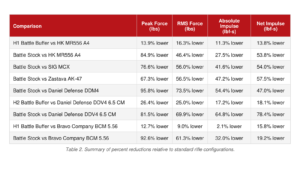
That makes stock design an important part of recoil reduction.
A recoil-reduction stock is not the same thing as a muzzle brake. It does not work from the same location or solve the problem the same way. A muzzle device influences gas and muzzle movement at the front of the firearm. A stock influences how force is transferred into the shooter at the rear.
Both can matter.
The best rifle setup is not always about one single part. It is about how the entire weapon system works together.
That includes the stock, buffer system, spring, gas system, muzzle device, optic setup, suppressor use, ammunition, and shooter position.
For shooters installing a Battle Stock, the Battle Stock Installation Guide provides setup information, installation steps, and basic fitment guidance.
Brace Design Is About Intended Use
Brace design is a different conversation.
A stabilizing brace is not supposed to be a disguised shoulder stock. Its design should support its stated purpose: stabilization of a pistol-style firearm.
That means the design and the product language need to match.
The geometry should make sense.
The marketing should be accurate.
The photos should not create confusion.
The dealer explanation should be clear.
The customer should understand what the product is and what it is designed to do.
This is where some companies make mistakes. They design one thing, describe it as another, and assume the label solves the problem.
That is not serious product development.
In the firearm industry, intent is not only what a company says in a product description. Intent can also be reflected in the product’s dimensions, shape, use case, marketing, compatibility, and overall configuration.
Why Shooters Get Confused
Shooters get confused because the language is often sloppy.
Some people call every rear firearm attachment a stock.
Some people call every AR pistol rear attachment a brace.
Some dealers use shorthand language at the counter.
Some manufacturers use vague product descriptions.
Online discussions often treat legal classification like personal opinion.
That creates confusion.
The better way to understand the issue is to ask what the part is actually designed to do.
Is it designed to be shouldered?
Is it designed to support the forearm?
Is it part of a rifle configuration?
Is it part of a pistol configuration?
Does the overall firearm appear designed and intended to be fired from the shoulder?
Those questions are more useful than simply asking what the part is called.
Why This Matters for Dealers
Dealers have to explain these products clearly.
A customer may walk into a shop and ask for an AR-15 stock, pistol brace, recoil-reduction stock, AK Picatinny stock, buffer upgrade, or short-barreled rifle setup without fully understanding the differences.
That puts the dealer in a difficult position.
A dealer does not need to give legal advice, but the dealer should understand basic terminology.
A rifle stock is not the same thing as a stabilizing brace.
A stabilizing brace is not just a shorter stock.
A recoil-reduction stock is not the same thing as a pistol brace.
A buffer system upgrade is not the same issue as a rear accessory classification question.
These distinctions matter because they affect how products are sold, installed, described, and understood.
For dealers interested in carrying Battle Brace products, the most important thing is to understand the product category and the intended use. Battle Brace products are built for serious shooters who care about recoil control, rifle stability, and practical weapon handling.
Why This Matters for Manufacturers
For manufacturers, the stock-versus-brace issue is even more important.
Product development has to happen inside the boundaries of the law, current regulatory guidance, engineering reality, and the company’s intended use case.
That means a manufacturer has to think like an engineer, a shooter, and a compliance-minded business at the same time.
A rear firearm accessory has to be strong enough to work, shaped correctly for its intended function, described accurately, tested honestly, and presented responsibly.
That is not easy.
It is much easier to make a part that looks aggressive than to make a part that is mechanically useful, properly described, and commercially viable.
Battle Brace is built around the second approach.
We care about recoil reduction, weapon control, durability, and measurable performance. We also care about building products that are described honestly and used for the purpose they were designed to serve.
Stock vs. Brace: Simple Summary
A rifle stock is designed for shoulder-fired use.
A stabilizing brace is designed to help stabilize a pistol-style firearm through arm support.
A stock is generally associated with rifles.
A brace is generally associated with large-format pistols and AR pistols.
A stock is built around shoulder contact.
A brace is built around stabilization rather than shoulder-fired design.
A stock can be part of a recoil-control system.
A brace exists in a more complex classification space where design, configuration, dimensions, marketing, and intended use can all matter.
That is the difference.
Not just the name.
Not just the look.
The design intent.
Common Search Terms Related to Stocks and Braces
Shooters often search for this topic using different phrases. Some call it stock vs. brace. Others search for pistol brace rules, ATF brace rule, AR pistol brace, rifle stock definition, short-barreled rifle, SBR, NFA rifle definition, stabilizing brace, recoil-reduction stock, AR-15 stock, AK Picatinny stock, or AR-15 recoil reduction.
The reason all of these terms overlap is because the rear of the firearm sits at the intersection of design, performance, and classification.
That is why this topic continues to matter across the firearm industry.
A shooter trying to reduce AR-15 recoil may be looking for a better stock.
A shooter building an AK platform may be looking for a rear Picatinny stock.
A dealer may be trying to explain the difference between a rifle stock and a pistol brace.
A manufacturer may be studying how design features affect classification.
All of these conversations connect back to the same basic question:
What is the part designed to do?
Final Takeaway
The difference between a stock and a brace is not a small technical detail. It is one of the most important distinctions in the modern firearm accessory market.
For shooters, it affects how a firearm is configured.
For dealers, it affects how products are explained.
For manufacturers, it affects how products are designed, tested, marketed, and documented.
The proposed ATF Worksheet 4999 point system showed how seriously design features can be evaluated. The later brace-rule fights showed how difficult and contested this area of firearm regulation has become.
The safest way to understand the issue is to focus on the core question:
Is the firearm designed and intended to be fired from the shoulder?
That question sits at the center of the stock-versus-brace discussion.
At Battle Brace, our focus is clear: build serious firearm accessories that improve control, reduce recoil, and give shooters a better system behind the gun.
Explore the Battle Stock for AR-15 platforms, view the Picatinny Battle Stock for AK platforms, or read the Battle Stock Installation Guide for setup and compatibility.
Sources and Further Reading
26 U.S.C. § 5845 — Federal definition of rifle and other firearm classifications
ATF / Federal Register — 2021 proposed factoring criteria for firearms with attached stabilizing braces
ATF / Federal Register — 2023 final rule on factoring criteria for firearms with attached stabilizing braces
ATF / Federal Register — 2026 proposed removal of factoring criteria for firearms with attached stabilizing braces
Disclaimer: This article is for general educational purposes only and is not legal advice. Firearm laws, regulations, classifications, and enforcement positions can change. Always review current federal, state, and local law, and consult qualified legal counsel when needed.