Battle Buffer Recoil Test: How Much Recoil Do Our Buffers Reduce?
A buffer is not just a weight inside the back of an AR.
It affects bolt speed, recoil feel, cycling behavior, rearward impact, and how the rifle returns after each shot.
That is why Battle Brace developed our Battle Buffer system around the same goal as the Battle Stock: better recoil control without turning the rifle into a science project.
Our H1 Battle Buffer comes standard with a stainless steel flatwire spring for our proprietary Battle Stock system. That spring and buffer setup is part of the reason the system can run inside the shortened stroke created by the technology in the rear of the stock.
Why Our Buffer Had to Be Different
A standard AR buffer system has more room to work with.
Our system does not.
Because the Battle Stock uses rear internal recoil-reduction technology and canting technology, the available stroke inside the system had to be shortened. That means the buffer and spring could not simply be copied from a standard carbine setup.
We had to account for less space.
We had to control rearward movement.
We had to maintain function.
We had to use heavier materials to make up for the reduced operating room.
That is the engineering problem behind the Battle Buffer.
It is not just about making a buffer heavier. It is about controlling the recoil cycle inside a more compact and more advanced rear stock system.
What the Battle Buffer Is Designed to Do
The Battle Buffer is designed to help manage the rearward movement of the rifle’s operating system.
In simple terms, it helps control how hard and how fast the rifle cycles.
That matters because recoil is not only the explosion at the muzzle. It is also the movement of the internal parts, the rearward impact of the operating system, and the way that force transfers into the shooter.
A better buffer system can help reduce the sharpness of that event.
Battle Buffer Test Results
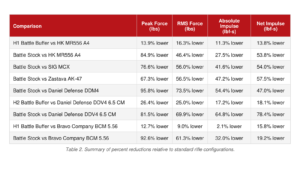
In live-fire Recoil-IQ testing, the Battle Buffer produced measurable recoil reduction across tested platforms.
H1 Battle Buffer vs. HK MR556 A4
On the HK MR556 A4, the H1 Battle Buffer reduced:
- Peak Force by 13.9%
- RMS Force by 16.3%
- Absolute Impulse by 11.3%
- Net Impulse by 13.8%
That means the H1 Battle Buffer reduced the hardest recoil hit, reduced the overall harshness of the recoil event, and lowered the total recoil load transferred through the system.
H2 Battle Buffer vs. DDV4 6.5 Creedmoor
On the Daniel Defense DDV4 6.5 Creedmoor, the H2 Battle Buffer reduced:
- Peak Force by 26.4%
- RMS Force by 25.0%
- Absolute Impulse by 17.2%
- Net Impulse by 18.1%
That is a strong result for a buffer-only change, especially on a larger 6.5 Creedmoor platform.
H1 Battle Buffer vs. BCM 5.56
On the BCM 5.56, the H1 Battle Buffer reduced:
- Peak Force by 12.7%
- RMS Force by 9.0%
- Absolute Impulse by 2.1%
- Net Impulse by 15.8%
Even when the total impulse change was smaller, the buffer still showed measurable improvement in peak force, RMS force, and net impulse.
Why Buffer-Only Results Matter
The Battle Stock is the main recoil-reduction system.
But the buffer still matters.
The data shows that even before looking at the full Battle Stock setup, the Battle Buffer can help reduce recoil measurements by itself.
That matters for shooters because recoil control is not one single part. It is a system.
The stock matters.
The buffer matters.
The spring matters.
The gas system matters.
The muzzle device matters.
The shooter’s position matters.
When those parts work together, the rifle becomes easier to control.
Built for the Battle Stock System
Our H1 Battle Buffer and stainless steel flatwire spring come standard with the Battle Stock because they are part of the system.
The rear of the Battle Stock is not empty space. It contains recoil-reduction technology and canting technology that changes how the system has to be engineered.
Because of that, the buffer stroke had to be shortened compared to a standard buffer tube setup.
That shortened stroke required heavier materials and a more deliberate spring and buffer design.
The result is a compact rear system built for recoil control, function, and weapon handling.
Final Takeaway
The Battle Buffer is not a basic replacement part.
It is part of the Battle Brace recoil-management system.
In Recoil-IQ testing, Battle Buffer setups reduced peak force, RMS force, absolute impulse, and net impulse across tested platforms. The H1 Battle Buffer showed measurable improvement on 5.56 platforms, and the H2 Battle Buffer showed strong recoil reduction on the DDV4 6.5 Creedmoor.
For shooters running the Battle Stock, the included H1 Battle Buffer and stainless steel flatwire spring are part of the reason the system works inside a shortened rear stroke.
Explore the Battle Stock for AR-15 platforms, view the Picatinny Battle Stock, or read the Battle Stock Installation Guide for setup and compatibility.
Disclaimer: Test results reflect specific tested rifle configurations, ammunition, equipment, and conditions. Results may vary by platform, setup, shooter, and configuration.